Showing posts with label EU Commission. Show all posts

Wednesday, 7 September 2016

Cork 2.0 Declaration

The original Cork Declaration was made 20 years ago, from it developed the Pillar 2 of the Common Agricultural Policy and a realisation that Direct Payments to agriculture had to go beyond the production related payments that had existed up until then. The result in Ireland was the roll out of schemes like REPS, Disadvantaged Areas Scheme, AEOS, GLAS and TAMS etc. Twenty years on from that date it was felt that this original vision needed to be updated and that a new declaration was needed to guide the development of Rural development Policies in the years ahead. 

It was for this reason that the EU Commission organised the Cork 2.0 conference on September 5th & 6th. Over 300 delegates from all 28 member states, from the EU Commission and with observers from China and the United States attended. The delegates included Farmers, Farmer Representative Organisations, Farm Advisors, Industry Representatives, Ministry of Agriculture Officals, Diplomats and Politicians. I was delighted to be asked to attend, I must stress that it is rare for me to be in such distinguished company.

A very significant number of delegates were from the UK and they made a considerable contribution, Brexit was hardly mentioned even by the UKIP MEP Stuart Agnew, although his opinions on addressing the causes of climate change as opposed to adapting to the impacts of Climate change did not engender much in the way of support. That aside the gathering was workmanlike, positive and productive. 

It would be impossible for me to address all of the many issues that were discussed at the conference but  some of the points that stood out for me include;


  • The need to add value rather that just quantity  to production systmens
  • The need to reconnect the consumer particularly the urban consumer with the food producer,
  • The value of the public goods produced by farmers, e.g. biodiversity, landscape resilience should be considered in the development of RDP policy.
  • Financial Instruments to support RDP policy, particularly the use of loan guarantees and subsidised interest rates as a support mechanism for rural development is likely to grow considerably in the future.
  • That overall funding in the future will be less, but that it should be better focused and that bottom up initiatives and results based programs are the way ahead. My reading of this is that capital schemes like TAMS could well be replaced with low interest loans and that catch all schemes like GLAS have had their day but we will wait and see.  


My overall impression was positive but I believe the next CAP will be very different and that every one involved in agriculture or in rural development will have to adapt to a radical change in policy direction. There will be new opportunities and some of them may well be far better than those that currently exist but I would temper this with a warning that there will be losers as well as winners. 


You can read the entire declaration by following the link below. 


http://ec.europa.eu/agriculture/events/2016/rural-development/cork-declaration-2-0_en.pdf


Fergal Monaghan


Thursday, 4 February 2016

Country Reports on the Implementation of the CAP.


The European Forum for Nature Conservation and Pastoralism have published a series of reports on the implementation of the CAP in different EU member states. These reports have a particular focus on how the the RDP in each state impacts on pastoral farming and on farmers utilising marginal lands. The reports include ones for Ireland, Bulgaria, Estonia, France, Spain and the UK. 

The reports are a very good synopsis of how the member states have implemented the CAP. What is particularly interesting is the range of different interpretations that the different countries have taken. The regulations at EU level are the obviously common to all but the range of approaches taken in different member states demonstrates the flexibility contained within the regulations. 

Links to the country reports can be found below.


http://www.efncp.org/download/IrelandCAPandpermanentpasturesimplementation.pdf

http://www.efncp.org/download/BulgariaCAPandpermanentpasturesimplementation.pdf

http://www.efncp.org/download/EstoniaCAPandpermanentpasturesimplementation.pdf

http://www.efncp.org/download/FranceCAPandpermanentpasturesimplementation.pdf

http://www.efncp.org/download/SpainCAPandpermanentpasturesimplementation.pdf

http://www.efncp.org/download/UKCAPandpermanentpasturesimplementation.pdf

Sunday, 14 December 2014

Irish RDP Application will not be approved in 2014.

Irelands RDP application will not be approved before the end of the year. A press release from the EU Commission has confirmed that the first 3 RDP applications have been approved. These were from Austria, Denmark and Poland, a further 6 (from Finland, Portugal along with 4 from Germany) will be agreed before the end of the year.  
While this is disappointing, it is not surprising, considering the scale of the task faced by the EU Commission in dealing with all 118 applications.  In addition the task of rewriting large parts of the Irish RDP to address the 266 observations made by the Commission will inevitably take some time.  

At this stage getting the plan right is certainly worth a couple of months delay. There is still time to make the adjustments necessary to deliver high quality schemes to support Irish Agriculture for the rest of the decade. It is essential that those who can secure this do not waste the opportunity, it will not come again!
The full text of the EU Commission press release can be seen below.

First three Rural Development Programmes get green light

Brussels, 12 December 2014
The European Commission has today approved the first three of 118 Rural Development Programmes (RDPs) aimed at improving the competitiveness of the EU farming sector, caring for the countryside and climate, and strengthening the economic and social fabric of rural communities in the period until 2020. Operating at either national or regional level, the 118 multi-annual programmes are backed by EUR 95.6 billion of total EU funding over the period 2014-2020 through the European Agricultural Fund for Rural Development (EAFRD) and will draw in additional national, regional and private finance. In addition to today’s programmes – the national RDPs for DenmarkPoland and Austria – a further 6 programme[1] will be adopted before the end of the year, meaning that programmes worth more than 20 billion EURO will have been cleared.
Agriculture and Rural Development Commissioner Phil Hogan said:
  • "Our rural areas – with the farm sector and the many other types of business which are based there – give us jobs, opportunities for rest and recreation, natural beauty, and pleasant places in which to live and work. But they need help to unlock their full potential. The next generation of Rural Development programmes is about to deliver that help. Today we have approved the first 3, with a further 6 to follow next week – accounting for roughly 22% of Rural Development spending from the EU budget. We estimate that programmes covering approaching one third of the funding will be cleared by Easter.
  • One of the great strengths of our Rural Development concept is that we have 6 core priorities, but it is up to each Member State or region to design programmes which suit their situation. And we see good examples of this today where the Polish programme is aiming to create more than 22 000 jobs, provide investment support to roughly 200 000 farms and to establish some 1 800 producer groups.
  • In Denmark, we see particular emphasis given to fostering innovation, with the objective of creating almost 1000 "green jobs", moves to double the area of organic farming, and investing in environmentally-friendly farming practices.
  • In Austria, there is particular priority given to environment and climate concerns, with a target of more than 80% of agricultural land managed to protect and enhance biodiversity, and training opportunities for more than 600 000 farmers, whilst around half the rural population should benefit from improved services such as high-speed broadband.
  • As I have seen in my native Ireland, a modern and dynamic agriculture sector can provide a motor for economic growth and jobs, especially in rural areas. In their Rural Development Programmes backed by EU funds, Member States and regions have the right key to unlock that potential.”
Background
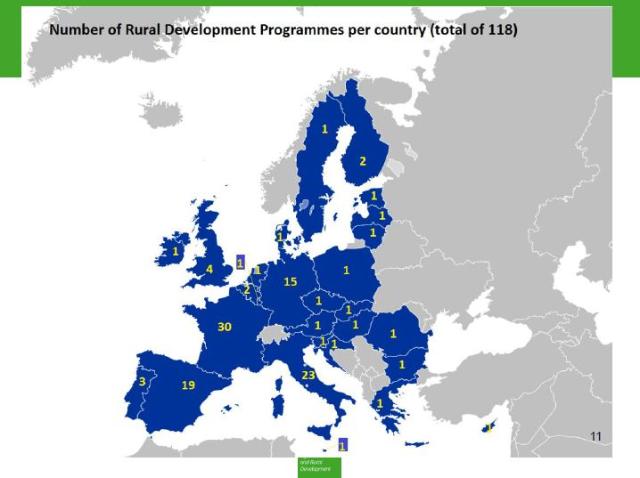
Rural Development is the so-called 2nd Pillar of the Common Agricultural Policy, providing Member States with an envelope of EU funding to manage nationally or regionally under multi-annual, co-funded programmes. In total, 118 programmes are foreseen in all 28 Member States.
number of RDPs by country
The new Rural Development Regulation for the 2014-2020 period addresses six economic, environmental and social priorities, and programmes contain clear targets setting out what is to be achieved. Moreover, in order to coordinate actions better and maximise synergies with the other European Structural & Investment Funds (ESIF), a Partnership Agreement has been agreed with each Member State highlighting its broad strategy for EU-funded structural investment.
[1] The following plans are due for adoption before the end of 2014: Finland (mainland); PortugalContinente; and 4 from Germany (the National Framework, the German Rural Network and the regional programmes for Sachsen, and Sachsen-Anhalt)

Saturday, 6 December 2014

The 266 Questions

The issue of how commonages should be dealt with under the various direct payment schemes is once again centre stage. The problem has if anything got more complex since the EU Commission responded to Irelands RDP application. The Commission has raised 266 questions with the Irish Authorities regarding the application lodged last July. Some of these are minor points that can easily be clarified and many have no impact on the commonage issue.  However there are several that strike right at the heart of the Dept. of Agricultures strategy for the next RDP and have a particular relevance for commonages.
 

These are;

14) The Irish authorities are asked to clarify the role of the Food Harvest 2020 strategy in relation to the strategy of this rural development programme. It seems that a number of needs are derived directly from Food Harvest 2020 instead of coming out of the ex-ante evaluation, the SWOT analysis and the needs assessment of this programme. The RDP has to be based on the established EU objectives and priorities and an analysis of the specific needs in Ireland. The Irish authorities are invited to set out how the RDP will align its strategic choices with these objectives. Food Harvest 2020 cannot be at the centre of the RDP's strategy. Especially the statement in section 8.2.4.2 that the GLAS scheme has been designed to mitigate the environmental impacts of Food Harvest 2020 raises concerns and needs explanation. In addition, Food Harvest 2020 seems to have a strong focus on production and export increase. Considerations about expanding export volumes do not have a place in a rural development programme, and all rural development measures have to be in line with international obligations under the WTO Agreement.
 
 40) Also under opportunities the creation of new habitats and the protection of blanket bog and upland commonage are mentioned. These do not seem to have been taken up in the programme. The Irish authorities are asked to justify this, especially as the peatland situation is also recognised as a threat.

134) The Irish authorities are asked to provide much more information concerning the logic, the objectives and the content of the commitments. This is necessary in order to make an analysis of the types of operations possible, notwithstanding some relevant information provided in Annex 2. Without seeing the details of the description of types of operations it is also impossible to assess the premia amounts proposed.

141) Which rules concerning land eligibility are adopted for this measure? Agricultural land, to be defined by the Member State for this measure, does not need to be limited to UAA.

149) What is the reason for specifically targeting commonages and for the required 50% minimum participation in a commonage plan?


In short the EU is questioning the use of the RDP as an instrument to further the objectives of Food Harvest 2020 and is pointing out the incompatibility of certain proposals that are contrary to WTO (World Trade Organisation) rules.  This is relevant to commonages because it effectively rules out the proposed minimum stocking rate of 0.1 LU/ Ha on marginal lands previously needed in order to qualify for the Basic Payment Scheme. 

As regards GLAS the Commission go onto question the measures or options within GLAS (which is not surprising as many of themhave clearly not been thought out), for example why the Hen Harrier measure does nothing to recognise the value in the preservation of habitat types other than rushy grassland (a relatively low value habitat).  Even worse the measure does not even allow for the conservation of hay or silage within Hen Harrier SPA’s. In short the measure is agriculturally impractical and of little conservation value. It is no wonder that the EU is confused.
Not only are such lands of considerable conservation value but they are also represent an enormous store of Carbon.  For a scheme that sees itself as “low Carbon” ignoring the role of peatlands in locking away Carbon is puzzling. If bogs or heaths are damaged, overgrazed, drained or cut much of this Carbon can be lost to the atmosphere. If they are well managed the bogs remain as a sink for atmospheric Carbon.  In short a bog that is well managed can help address the greenhouse gas issue, a bog that is inappropriately managed contributes to the problem by releasing CO2 as the peat dries out and breaks down. While considerable funds are available to keep organic Carbon locked away in grassland soils, e.g. €314/ Ha available under the Low Input Permanent Pasture Measure, no provision is made for achieving the same goals on peatlands. This is surprising as the amount of Carbon at stake on blanket bog on a per Ha basis) far exceeds that on most permanent pastures.  Furthermore well managed peatlands can store vast quantities of water, helping to regulate water flow, reduce the risk of downstream flooding and thus helping to make the catchment as a whole more resilient to the negative impacts of climate change

They also wonder why the option of making payments under an agri environmental scheme on lands that are not considered as UAA is not being taken up. They certainly have a point here, surely farmers protecting valuable habitats like limestone pavement or long established Ash Hazel scrub should be rewarded for doing so. There seems to be a fixation with scrub in some parts of the Dept. of Agriculture. I remember a senior official recently stating that scrub is not habitat, he may have a point in respect of encroaching Gorse or Blackthorn but Juniper scrub and established Ash Hazel scrub are valuable habitats and worthy of payment under any agri-environment scheme.  
Finally the EU Commission query why there is a 50% requirement for commonages. Surely if a plan is worth having or if certain tasks are worth carrying out then they are of value irrespective of the level of support.

A series of bilateral meetings between the Dept. of Agriculture and the EU Commission to discuss the queries raised by the Commission are taking place this month. The first of these has already taken place. While I am not privy to what goes on at these meetings and I know that the Dept. of Agriculture still appear quite confident, changes to the RDP are inevitable. We know that the 0.1 LU/ Ha on marginal lands is gone; there will be more changes yet. Hopefully the proposed scheme will develop further and many of the current weaknesses will be addressed in the very near future.