Showing posts with label RDP. Show all posts

Wednesday, 7 September 2016

Cork 2.0 Declaration

The original Cork Declaration was made 20 years ago, from it developed the Pillar 2 of the Common Agricultural Policy and a realisation that Direct Payments to agriculture had to go beyond the production related payments that had existed up until then. The result in Ireland was the roll out of schemes like REPS, Disadvantaged Areas Scheme, AEOS, GLAS and TAMS etc. Twenty years on from that date it was felt that this original vision needed to be updated and that a new declaration was needed to guide the development of Rural development Policies in the years ahead. 

It was for this reason that the EU Commission organised the Cork 2.0 conference on September 5th & 6th. Over 300 delegates from all 28 member states, from the EU Commission and with observers from China and the United States attended. The delegates included Farmers, Farmer Representative Organisations, Farm Advisors, Industry Representatives, Ministry of Agriculture Officals, Diplomats and Politicians. I was delighted to be asked to attend, I must stress that it is rare for me to be in such distinguished company.

A very significant number of delegates were from the UK and they made a considerable contribution, Brexit was hardly mentioned even by the UKIP MEP Stuart Agnew, although his opinions on addressing the causes of climate change as opposed to adapting to the impacts of Climate change did not engender much in the way of support. That aside the gathering was workmanlike, positive and productive. 

It would be impossible for me to address all of the many issues that were discussed at the conference but  some of the points that stood out for me include;


  • The need to add value rather that just quantity  to production systmens
  • The need to reconnect the consumer particularly the urban consumer with the food producer,
  • The value of the public goods produced by farmers, e.g. biodiversity, landscape resilience should be considered in the development of RDP policy.
  • Financial Instruments to support RDP policy, particularly the use of loan guarantees and subsidised interest rates as a support mechanism for rural development is likely to grow considerably in the future.
  • That overall funding in the future will be less, but that it should be better focused and that bottom up initiatives and results based programs are the way ahead. My reading of this is that capital schemes like TAMS could well be replaced with low interest loans and that catch all schemes like GLAS have had their day but we will wait and see.  


My overall impression was positive but I believe the next CAP will be very different and that every one involved in agriculture or in rural development will have to adapt to a radical change in policy direction. There will be new opportunities and some of them may well be far better than those that currently exist but I would temper this with a warning that there will be losers as well as winners. 


You can read the entire declaration by following the link below. 


http://ec.europa.eu/agriculture/events/2016/rural-development/cork-declaration-2-0_en.pdf


Fergal Monaghan


Thursday, 4 February 2016

Country Reports on the Implementation of the CAP.


The European Forum for Nature Conservation and Pastoralism have published a series of reports on the implementation of the CAP in different EU member states. These reports have a particular focus on how the the RDP in each state impacts on pastoral farming and on farmers utilising marginal lands. The reports include ones for Ireland, Bulgaria, Estonia, France, Spain and the UK. 

The reports are a very good synopsis of how the member states have implemented the CAP. What is particularly interesting is the range of different interpretations that the different countries have taken. The regulations at EU level are the obviously common to all but the range of approaches taken in different member states demonstrates the flexibility contained within the regulations. 

Links to the country reports can be found below.


http://www.efncp.org/download/IrelandCAPandpermanentpasturesimplementation.pdf

http://www.efncp.org/download/BulgariaCAPandpermanentpasturesimplementation.pdf

http://www.efncp.org/download/EstoniaCAPandpermanentpasturesimplementation.pdf

http://www.efncp.org/download/FranceCAPandpermanentpasturesimplementation.pdf

http://www.efncp.org/download/SpainCAPandpermanentpasturesimplementation.pdf

http://www.efncp.org/download/UKCAPandpermanentpasturesimplementation.pdf

Tuesday, 16 December 2014

GLAS Specifications.

The draft Specifications for GLAS can be seen by following the link below. These are an early draft and I expect there will be significant changes before the scheme is approved.


/GLAS Draft Specifications 

Sunday, 14 December 2014

Irish RDP Application will not be approved in 2014.

Irelands RDP application will not be approved before the end of the year. A press release from the EU Commission has confirmed that the first 3 RDP applications have been approved. These were from Austria, Denmark and Poland, a further 6 (from Finland, Portugal along with 4 from Germany) will be agreed before the end of the year.  
While this is disappointing, it is not surprising, considering the scale of the task faced by the EU Commission in dealing with all 118 applications.  In addition the task of rewriting large parts of the Irish RDP to address the 266 observations made by the Commission will inevitably take some time.  

At this stage getting the plan right is certainly worth a couple of months delay. There is still time to make the adjustments necessary to deliver high quality schemes to support Irish Agriculture for the rest of the decade. It is essential that those who can secure this do not waste the opportunity, it will not come again!
The full text of the EU Commission press release can be seen below.

First three Rural Development Programmes get green light

Brussels, 12 December 2014
The European Commission has today approved the first three of 118 Rural Development Programmes (RDPs) aimed at improving the competitiveness of the EU farming sector, caring for the countryside and climate, and strengthening the economic and social fabric of rural communities in the period until 2020. Operating at either national or regional level, the 118 multi-annual programmes are backed by EUR 95.6 billion of total EU funding over the period 2014-2020 through the European Agricultural Fund for Rural Development (EAFRD) and will draw in additional national, regional and private finance. In addition to today’s programmes – the national RDPs for DenmarkPoland and Austria – a further 6 programme[1] will be adopted before the end of the year, meaning that programmes worth more than 20 billion EURO will have been cleared.
Agriculture and Rural Development Commissioner Phil Hogan said:
  • "Our rural areas – with the farm sector and the many other types of business which are based there – give us jobs, opportunities for rest and recreation, natural beauty, and pleasant places in which to live and work. But they need help to unlock their full potential. The next generation of Rural Development programmes is about to deliver that help. Today we have approved the first 3, with a further 6 to follow next week – accounting for roughly 22% of Rural Development spending from the EU budget. We estimate that programmes covering approaching one third of the funding will be cleared by Easter.
  • One of the great strengths of our Rural Development concept is that we have 6 core priorities, but it is up to each Member State or region to design programmes which suit their situation. And we see good examples of this today where the Polish programme is aiming to create more than 22 000 jobs, provide investment support to roughly 200 000 farms and to establish some 1 800 producer groups.
  • In Denmark, we see particular emphasis given to fostering innovation, with the objective of creating almost 1000 "green jobs", moves to double the area of organic farming, and investing in environmentally-friendly farming practices.
  • In Austria, there is particular priority given to environment and climate concerns, with a target of more than 80% of agricultural land managed to protect and enhance biodiversity, and training opportunities for more than 600 000 farmers, whilst around half the rural population should benefit from improved services such as high-speed broadband.
  • As I have seen in my native Ireland, a modern and dynamic agriculture sector can provide a motor for economic growth and jobs, especially in rural areas. In their Rural Development Programmes backed by EU funds, Member States and regions have the right key to unlock that potential.”
Background
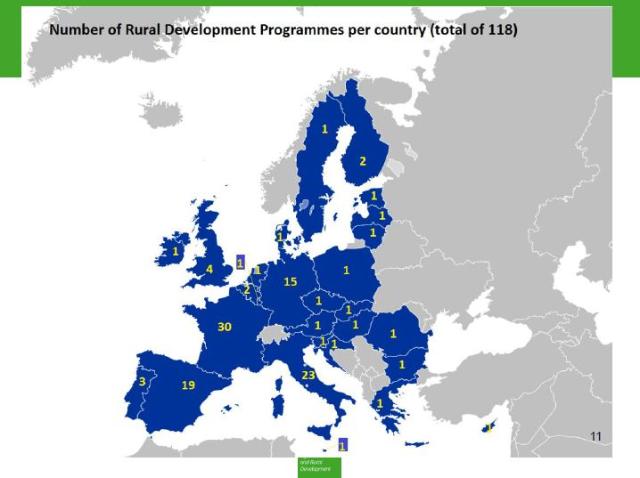
Rural Development is the so-called 2nd Pillar of the Common Agricultural Policy, providing Member States with an envelope of EU funding to manage nationally or regionally under multi-annual, co-funded programmes. In total, 118 programmes are foreseen in all 28 Member States.
number of RDPs by country
The new Rural Development Regulation for the 2014-2020 period addresses six economic, environmental and social priorities, and programmes contain clear targets setting out what is to be achieved. Moreover, in order to coordinate actions better and maximise synergies with the other European Structural & Investment Funds (ESIF), a Partnership Agreement has been agreed with each Member State highlighting its broad strategy for EU-funded structural investment.
[1] The following plans are due for adoption before the end of 2014: Finland (mainland); PortugalContinente; and 4 from Germany (the National Framework, the German Rural Network and the regional programmes for Sachsen, and Sachsen-Anhalt)

Monday, 15 September 2014

Commonage Crisis


The Dept. of Agriculture appear unmoved from their opening position regarding the need for collective agreements as a requirement for joining GLAS.  All concerned should now be aware that we are very close to a point of no return, immediate and meaningful engagement between the farmers and the Dept. of Agriculture must take place in the coming days if we are to avoid doing permanent damage to hill farming.  

It is not ideal, but the work that should have been carried out over the last two years must now be completed in two weeks or less.  If it is not, GLAS risks complete failure in hill areas.
  • For the farmers this could mean a complete loss of agri-environment payments in the current round of the CAP.  If this happens how many will be there for the next CAP?
  • For the state, key objectives of the RDP would be unattainable. The programme could effectively fail before it begins. This is an appalling vista and would have far reaching consequences.
  • For farm advisors in the west, failure will destroy their business model. Investments in increasing capacity to deal with GLAS planning in commonage areas have already been put on hold and many planners, increasingly nervous about the volatility in the sector are already looking for alternatives.
All parties should recognise that while they have their own priorities, their fates are linked. They should appreciate the effect of the current situation on the morale, not just of their own sector but on the other parties as well and the risk of undesired reactions that this creates.

Everyone must accept that there will be no imposed solution, there will be no point where one group can declare victory. If an agreement is not reached that all parties can accept then GLAS will fail and the consequences will impact on everyone.

The situation demands cool heads, an ability to compromise and prompt action. The stakes have never been higher.

Wednesday, 18 June 2014

GLAS, What will happen next?

What will happen next? The RDP application will be made at the end of the month, it will then be reviewed in Brussels, but as the Commission effectively shuts down for the month of August it is unlikely that formal approval will issue before late September.  The issuing of approval is unlikely to lead to an opening of the scheme in October, as the specifications for GLAS and the other schemes will still need to be finalised.  In addition I am sure that testing of the DAFM systems particularly software for the operation of the new scheme will still need to be completed.  All of these issues are likely to delay the opening for applications until late November/ early December at the earliest.
Between now and then all interested parties should pay close attention to the development of specifications and the terms and conditions for the new scheme, the fine detail in these documents may be of greater significance for farmers than the contents of the RDP application. Finally it is almost certain that we will see movement on the issue of an appeals board for the commonage review. How this will function and how it will fit in with the GLAS application window is still unclear but I expect more details on this will be available very soon.
While we have no firm indication of what the closing date for applications will be. However for all practical purposes it will effectively be the end of March 2015.  Once we get into April, farmers and farm advisors focus will have to shift towards SPS applications. If an application is not finalised by then it will be unlikely to get in to GLAS on the first round.  This leaves advisors with a maximum of four months to prepare 25,000 to 30,000 applications.  Considering the inevitable slow start this is a tall order. For this reason as well as for political considerations, I am certain that DAFM will not want to delay the opening of the scheme beyond early December.  Every day lost after that will have implications for the quantity and quality of applications.

GLAS and Commonage Management, Latest Developments.

The last round of consultation for the new RDP has closed and we expect the Dept. of Agriculture, Food and the Marine to make their application to Brussels by the end of the month. I hope that the details of the application will be published as soon as possible after they have been sent to the EU Commission.

As regards GLAS, I do not expect there will be significant changes from the structure proposed by the Dept. What we can hope for it that the process of filling in the information gaps that have contributed to the unease felt by many will pick up speed. However one key issue has been clarified in recent days, this is the method for calculating the qualified majority required for priority entry to the scheme. Minister Coveney has confirmed that the 50/ 80% required will be from the set of farmers currently declaring a share on the commonage and not from the total set of shareholders. This is an important development as a requirement for majority support of total shareholders would in many cases have been absolutely impossible. It is unfortunate that this issue was not dealt with many months ago as it could have eased some of the concerns of many commonage shareholders.

Monday, 26 May 2014

Recent Commonage Developments.

The Minister for Agriculture has announced further details of the RDP that will be submitted to Brussels at the end of June. Shortly after this the Dept. of Agriculture published the SEA (Strategic Environmental Assessment) of the RDP and an Appropriate Assessment of the RDP. The SEA is an overarching analysis of the environmental impacts positive and negative of the proposed measures. It also examines the steps that could be taken to mitigate the more adverse impacts. The AA is an examination of how the RDP impacts on NATURA sites, i.e. SAC and SPA lands. Inevitably there is a considerable overlap between the two documents. Both documents, along with the Ministers statement give us some further indication of the developing thinking on the commonage issue.

The most significant development is the introduction of a lower qualified majority for a commonage agreement for entry to GLAS at tier 2 priority. This is a welcome development and will facilitate progress on many commonages, the reduced priority attached to this lower qualified majority means that entry into GLAS may not happen till 2016. The second development of significance is the publication of the Dept. of Agriculture's target for GLAS participation among commonage farmers. They hope to have 150,000 Ha of commonage land in GLAS or GLAS+ contracts. This is about 50% of the commonage area declared on the 2013 SPS returns. This is ambitious and if it is to be realised considerable support for the process will be needed.

The lowering of the threshold for a qualified majority of shareholders will help, as will the Ministers statement in the Dail that mediators will be provided where required to facilitate agreements and that we can expect a roll out of this process over the next 12- 18 months. No information has been provided to date on how this would be done.

While we await developments on this issue it may be helpful to look at the situation in Wales where the Government there faced similar issues (albeit on a smaller scale). They opted to use LEADER and technical assistance funds to employ 18 Commonage Development Officers to facilitate agreements among commonage farmers. Is it possible that a similar approach could be used here?


http://www.agriculture.gov.ie/media/migration/ruralenvironment/ruraldevelopment/ruraldevelopmentprogramme2014-2020/RDP20142020DraftAppropriateAssessmentReport160514.pdf


http://www.agriculture.gov.ie/media/migration/ruralenvironment/ruraldevelopment/strategiesandprogrammes/SEAPublicConsultationDraftMaterialVersionMay12130514.pdf


http://www.agriculture.gov.ie/media/migration/press/pressreleases/2014/may/dafmpr7214.pdf


http://www.google.ie/url?sa=t&rct=j&q=&esrc=s&source=web&cd=1&cad=rja&uact=8&ved=0CDAQFjAA&url=http%3A%2F%2Fwww.teagasc.ie%2Fpublications%2F2013%2F2990%2FGwionAeron.pdf&ei=CHGDU9GZCaK47Abu3IDgCA&usg=AFQjCNFsfEYnyVMO9zmmEaUP57UDHJrFHA&sig2=_aoxPUSEY52tE8TunKAI4Q&bvm=bv.67720277,d.ZGU


Monday, 10 February 2014

Invitation to make submissions on draft RDP.

The Dept. of Agriculture are seeking written submissions on the recently published draft paper for the Rural Development Programme 2014-2020.

In relation to commonages the specific issues in the draft paper are;

1) The requirement for 80% of shareholders in a commonage to form a grazing association in order to  apply for the GLAS scheme.
2) The payment ceiling and administrative issues under GLAS.
3) The convergence of low value entitlements towards a minimum of 60% of the national average value.
4) The merging of the payments under the sheep grassland scheme into the a farmers entitlements under the basic payment scheme.

Unfortunately a lot of the fine print is still unclear. Farmers should note that the impact of these proposals will largely be determined by the regulations in the RDP and operating programmes that will be submitted to the EU Commission later in the Spring. This is your last chance to have a meaningful input into the design of these regulations. For this reason I would urge anyone who has a suggestion to make a submission before the closing date of Feb 19th 2014.

In connection with the issues listed above I believe that all commonage farmers should give careful consideration to the following points;

1) The requirement for 80% of shareholders in a commonage to form a grazing association in order to apply for the GLAS scheme.

       Is 80% to high?
  • Would lowering the threshold to 70% make an agreement more achievable? or would leaving out a large minority prevent any agreement from achieving its objectives, i.e. ensuring land remains in GAEC and eligible for payments?
  • How should dormant shareholders (shareholders who do not farm at all or do not declare commonage on their SPS return)be dealt with?
  • How should inactive shareholders(farmers who declare the commonage share on their SPS but do not utilise the commonage)be treated?
  • What issues should a grazing agreement include?
  • What issues should not be part of a grazing agreement?
  • How should the transaction costs for developing an agreement be met?
  • Should they be paid by the farmers?
  • Should they be paid for out of the funds available for knowledge transfer?
  • How much time should be available to develop commonage agreements? Note: Similar agreements in England have been found to take up to a year to put in place. This issue requires careful consideration as the current proposal is to have an agreement in place before applying for GLAS. This creates a risk that that most commonage farmers will not get into GLAS until 2016.
  • Should applications be allowed prior to agreement, provided agreements are in place prior to payment?
2) The payment ceiling and administrative issues under GLAS.
  • Is the proposed payment ceiling of €5,000 adequate?
  • How should eligibility for the GLAS+ supplement be determined? Should farmers with very large areas of commonage be eligible?
  • Should active shareholders in commonages with a high dormancy rate be eligible?
  • Should farmers with commonage in Freshwater Pearl Mussel catchments where additional measures are likely to be required be eligible for the top up?
  • Should amendments to GLAS plans be allowed?
  • Considering that commonage agreements may require on going tweaking to deal with future developments and issues unforeseen when the original agreement was drawn up this may be a vital requirement for effective operation of any scheme. For this reason is it important that grazing agreements and GLAS plans can be amended?
3) The convergence of low value entitlements towards a minimum of 60% of the national average value by 2019.
  • Payments on lands "kept naturally in a state suitable for grazing" will be dependent on maintaining a certain minimum level of activity.
  • This issue has not yet been addressed but in many ways is the most important of all. If handled inappropriately it could exclude thousands of commonage farmers. It deserves careful attention by all concerned.
  • How should a minimum level of activity be defined? Should it be a minimum stocking rate? How can such a definition be applied to a very diverse set of commonages?
4) The merging of the payments under the sheep grassland scheme into the a farmers entitlements under the basic payment scheme.
  • While this will give an initial boost to payments, for most farmers this benefit will be lost by 2019 as the value of entitlements converge.
  • Should the grassland sheep payment be retained as it is?
  • Or is the Minister correct when he says that the payment if not subsumed into the basic payment scheme might be lost completely?
You can download the draft paper through the links on this page.

Think about the issues involved and make a submission if you can. You can also leave a comment on this site or send us an e-mail to yourcommonage@gmail.com

Invitation to make Submissions.

http://agriculture.gov.ie/media/migration/ruralenvironment/ruraldevelopment/ruraldevelopmentprogramme2014-2020/InvitesubmissionsRDPConsultationPaper21012014.pdf

Draft Paper on RDP

http://agriculture.gov.ie/media/migration/press/pressreleases/2014/DraftConsultation%20DocRDP14%20Jan.pdf

Editors Notes

http://agriculture.gov.ie/media/migration/press/pressreleases/2014/NOTESFOREDITORS140114.doc